The Futurescapes Navigator – A Scenario Game For Exploring Futures

The Futurescapes Navigator is a tool designed for both research and practice to support the collaborative exploration of complex and interdependent conflicts. While the simulation game was originally developed in the context of water conflicts, its underlying principles and the web application can be applied to other conflict areas as well—wherever future uncertainties and complex interrelations play a significant role.
Purpose of the game
- Objective (content):
To make the effects of one’s own actions—as well as those of other actors—tangible under different future scenarios, and to explore possible joint, contradiction free, synergistic, and robust combinations of measures (policy-mixes). - Objective (process):
To foster collaboration across disciplines and sectors; to bring actors together and encourage communication; and to make alternative courses of action and their interconnections transparent.
ACCESS AND MATERIAL
The current version of the Futurescapes Navigator is a workshop prototype, which will be further developed and refined in future research projects. Currently, the application is in German, a translation to English is planned.
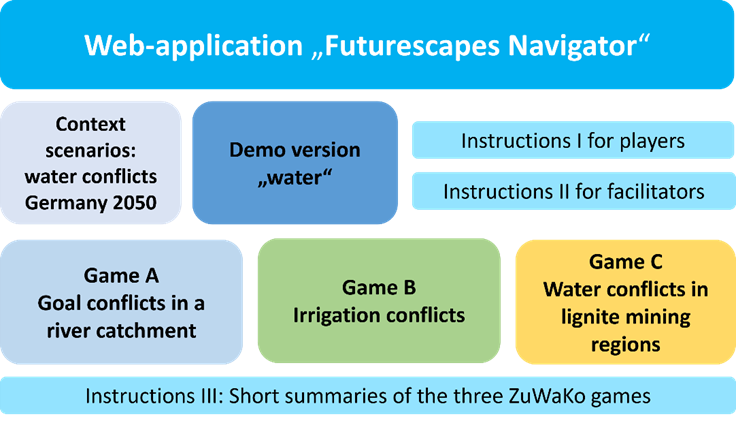
Registration: https://scenariowizard.org/FuturescapesNavigator/login/FN.php
- Game instructions for players (in German)
- Game instructions for facilitators (in German)
- Short summaries of the three ZuWaKo games: A: “Goal conflicts in a river basin” , B: “Conflicts over irrigation” , and C: “Water conflicts in lignite mining regions”: Instructions_three_water_games (in German)
BAckground: What is a serious game?
Serious games are teaching and exercise methods in which the participating persons playfully take on roles in a reality-based but model-like decision-making task and are told the effect of their decisions through a simulation. The goal of a serious game is to provide the participating persons with a deeper understanding of the decision-making task. Role reversal and dialogue based on the simulation can also improve decision-making competence for the task in question (“action learning”).
Role in the project
In the ZuWaKo project, serious games are used to work through the qualitative conflict models developed in the case studies together with the actors involved. In doing so, the interdependencies of the actors’ decisions caused by side effects are to be made visible and the complexity of the conflict situations is to be made tangible. In this way, the conditions characteristic of a future conflict scenario in their various manifestations are specifically set as framework conditions within which the players can experimentally set their goals and decisions and reflect on them through the reactions in the overall system.
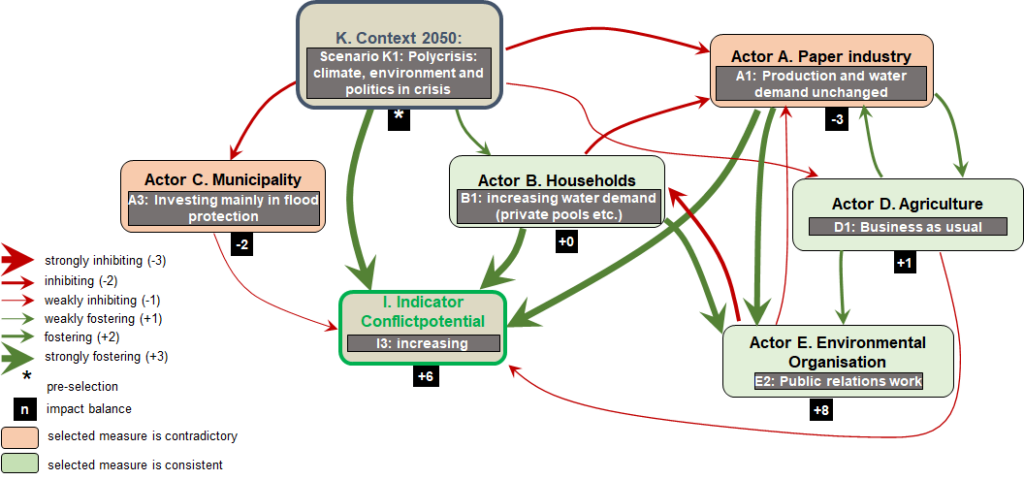
CIB analysis is used as a method for qualitative simulation of conflict interdependence. The conflict models of the three modules (Module A, Module B, Module C) are formulated in terms of cross-impact matrices. The CIB analysis then enables each decision maker to show the consequences of the decisions of the other participants for his/her own decision field.
The CIB simulation is implemented in a web-based simulation interface, the so called “Futurescapes Navigator. This application can be run online, independent of location and system. This makes it possible for actors to come together in a low-threshold way and to exchange information about their respective positions.
BASIC LOGICS OF THE ZUWAKO SERIOUS GAMING APPROACH

Development and use of the simulation game
The serious game and the web application had been first developed in a preliminary version and then elaborated for practical use in a participatory co-design process together with the participating actors. Within the project, a workable workshop version of the Futurescapes Navigator that can be used for serious gaming has been developped.
In addition to the use with the participating actors in the case studies, the serious game has also to be tryed out in the university teaching of the project partners. On the basis of the experiences gained in this way, the application has been revised and accompanying materials developed for independent use of the simulation by third parties have been developed.
Simplified ExaMPLE of a CIB SERIOUS GAMING MODEL